
Mizuno is the major running brand most shoe guides skip, and that is a genuine loss. While rivals chase ever softer foams, Mizuno has spent three decades refining a different idea: a wave shaped plate that spreads impact and gives the ride a structure you can feel.
I am Muhammad, editor of RunningShoes.fit, and this guide covers the best Mizuno running shoes right now, led by the Wave Rider 30, the anniversary redesign of the brand’s flagship trainer. If you have ever found modern shoes too soft, too tall, or too vague underfoot, Mizuno is the brand that was built for you.
What makes Mizuno different
Every serious Mizuno shoe carries the Wave plate, a corrugated plate inside the midsole that does two jobs at once. It disperses landing forces across a wider area, and it adds a spring and structure that foam alone cannot, which is why Mizuno shoes feel firmer and more deliberate than their stack heights suggest.
Wave plate, Foam Wave, and the rest of the range
The rigid Wave plate in the Rider and Neo Vista spreads impact and adds structure, while the Foam Wave in the Wave Sky 9 is a softer version that adds stability without firmness. The Wave Sky 9 is the max cushion neutral shoe, for runners who want the softest Mizuno ride.
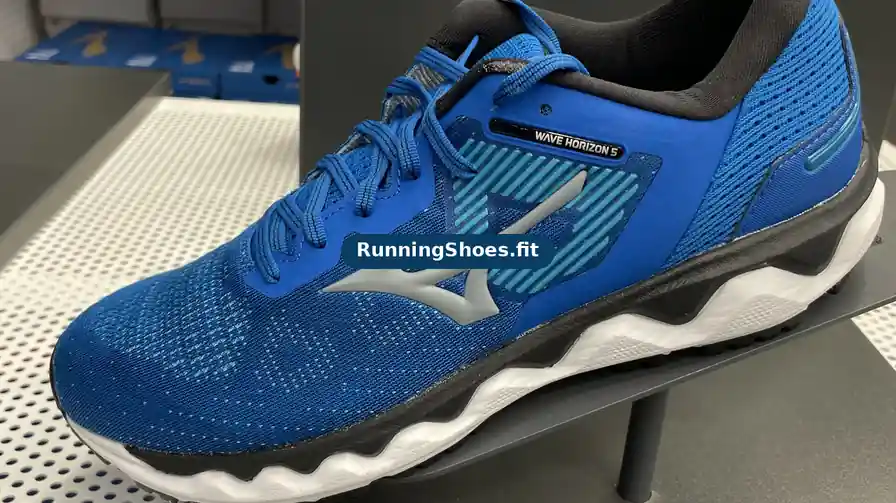
Overpronators have two current options. The Wave Inspire 22 is the everyday stability trainer, with full length Enerzy Nxt cushioning on a 10mm drop and wide and super wide options, while the Wave Horizon 9 is the maximum support shoe for long easy miles. Our best stability running shoes for overpronation guide explains how to tell if you need that guidance.
The Wave plate feel
Run in a Mizuno and the sensation is guidance rather than sinking. The plate keeps the shoe stable through the stride and gives toe off a defined snap, and runners who grew up on traditional trainers tend to describe it as running in a shoe that knows what it is doing.
Enerzy foams, tuned firmer
Mizuno’s Enerzy foam family now includes nitrogen infused versions that are lighter and bouncier than the EVA of old. Even so, Mizuno tunes its foams a step firmer than Hoka or New Balance, and that is a feature, not a flaw: the shoes stay composed at any pace and last a long time doing it.
The range splits cleanly into three jobs. The Wave Rider line covers daily training, the Neo line covers fast training, and the Wave Rebellion line covers racing, which makes Mizuno one of the easiest brands to shop once you know your job description.
Durability is the quiet selling point
Ask long time Mizuno runners why they stay, and few mention race results. They talk about shoes that still feel honest at 400 miles, outsoles that refuse to wear smooth, and a ride on day one hundred that resembles the ride on day one, and in a market of foams that fade by spring, that consistency is Mizuno’s real signature.
The best Mizuno running shoes
Best daily trainer: Mizuno Wave Rider 30
The Wave Rider 30 is a landmark shoe: the first Rider with a full length Wave plate, in the model’s 30 year history. Mizuno paired it with a dual layer Enerzy Nxt midsole, nitrogen infused on top for energy return over a steadier base, and dropped the offset to 8mm from the classic 10mm and 12mm of older Riders.
Wave Rider 30: what the redesign changes on the run
The Rider 30 is still the current model, at about $150, with a 42.5mm heel and 34.5mm forefoot stack on an 8mm drop. The taller stack and lower drop are the real changes from the Rider 29, which sat at 10mm with a lower heel, so the 30 feels more cushioned. The full length Wave plate keeps that cushioning controlled, so the shoe still feels guided rather than vague.
At about 264g for a men’s US 9, the engineered knit upper fits roomy, so some runners go down half a size. The Rider 29 is now the value buy, at a lower price on sale. The drop change is explained in our heel drop explained guide.
The result is the most modern Rider ever made: about 42.5mm of stack under the heel, a smooth cruise at easy and steady paces, and a price of about $150 that undercuts most flagship trainers. The full specification is on Mizuno’s official Wave Rider 30 page, including the wide 2E version, which is rarer than it should be among Japanese brands.
Fit runs roomy, and some runners size down half a size. Buy it as your default daily trainer, and it will still be working when softer rivals have gone flat, which is the traditional Rider promise kept for another generation.
Best for fast training: Mizuno Neo Vista 3
The Neo Vista 2 is Mizuno’s super trainer, and it shows how far the brand has come. A tall stack of Enerzy Nxt foam works with a glass fibre Wave plate and Mizuno’s Smooth Speed Assist rocker geometry, so the shoe rolls forward eagerly and holds that rhythm through long tempo efforts.
At about $180, it competes with the plated trainers in our tempo guide rather than with ordinary daily shoes.
The fast trainer in this guide has moved on. The Neo Vista 3 is the current model, released in June 2026 at about $200, and it replaces the Neo Vista 2. It keeps the dual layer Enerzy Nxt midsole, a nitrogen infused TPU top layer over an EVA base, with a glass fibre Wave plate, on an 8mm drop. The base sits slightly lower than in the Vista 2, and the ride is a little firmer and more controlled.
That makes the Vista 3 the pick for marathon training blocks, while the Vista 2 is now the value buy on sale. Fit note: the Vista 3 has no wide version listed, and the knit upper can feel tapered for broader feet.
The feel is the surprise: bouncy and modern, but with that Mizuno structure underneath, so it never turns into the wobbly marshmallow that some super trainers become at slower paces.Choose the Neo Vista 2 for marathon training blocks, progression runs, and runners who want one shoe for workouts and long runs. Pure easy days still belong to the Rider, which is the calmer tool.
Best for race day: Mizuno Wave Rebellion Pro 3
The Wave Rebellion Pro 3 is Mizuno’s marathon racing flagship: a carbon plated shoe with the lightest Enerzy foams in the range and an aggressive Smooth Speed Assist geometry that tips you forward and dares you to keep up. It is unapologetically a race day instrument, priced around $250 like every other super shoe.
The Rebellion Pro 3 is still the current Mizuno racer, at about $250. It works best for midfoot and forefoot strikers with efficient form who race marathons and half marathons. It weighs about 225g for a men’s US 9, and the carbon plate and Smooth Speed Assist geometry reward committed, fast running.
It does not suit heel strikers, runners who want one shoe for daily miles, or anyone who runs mostly easy paces, because the geometry feels unusual at slow speeds and the racing foam wears faster than trainer foam. Save it for races and rehearsal workouts, and buy it on sale if you can, since clearance prices have started to appear.
Be ready for the ride. The Rebellion geometry feels unusual at slow paces and rewards committed, fast running, which is why it belongs in the same conversation as the racers in our guide to the best marathon running shoes rather than in an everyday rotation.
Save it for races and a couple of rehearsal workouts. The racing foams and extreme geometry are not built for daily mileage, and treating it as a trainer is an expensive way to learn that.
| Shoe | Role | Best for |
|---|---|---|
| Mizuno Wave Rider 30 | Daily trainer, full length Wave plate | Everyday miles with structure |
| Mizuno Neo Vista 3 | Super trainer, glass fibre plate | Tempo work and marathon training |
| Mizuno Wave Rebellion Pro 3 | Carbon racer | Marathon and race day speed |
How Mizuno compares
Think of Mizuno as the firm, structured end of the daily trainer market. Against the softness first approach of the brands in our best Asics running shoes and best Brooks running shoes guides, Mizuno feels more deliberate, and runners who dislike sinking into foam usually prefer it.
That makes the Wave Rider 30 a genuinely different answer to the daily trainer question, not just another entry on the list. It also earns a mention in our roundup of the best running shoes to buy in 2026, where structure and durability count for as much as softness.
Who should try Mizuno
Start with Mizuno if your current shoes feel too soft, if you want a trainer that lasts, or if you are a beginner who needs a shoe that feels stable without being a stability shoe.
Most models run true to size, with the Rider 30 the roomy exception, and the X10 carbon rubber outsole resists wearing smooth, so 400 to 500 miles is a realistic expectation from the training models. Heavier runners can compare these picks with our best running shoes for heavy runners guide.
Mizuno does not suit every runner. If you want the softest possible landing or the lightest tempo shoe, rivals do those jobs better. But if you want a structured daily trainer that feels the same at mile 400 as on day one, the Rider 30 is the honest starting point, with the Sky 9 above it for comfort and the Neo Vista 3 above it for speed.
The Rider’s honest, guided ride is exactly why it appears in conversations about the best running shoes for beginners more often than the brand’s marketing suggests.The Run Testers review of the Wave Rider 30 lands in the same place: a comfortable, protective daily trainer whose structure makes it easy to trust. If that description sounds like the shoe you have been missing, it probably is.
One practical note on availability: Mizuno sells through fewer shops than Nike or Brooks in many regions, so try the Rider on where you can and lean on the wide fit if your local store only stocks standard widths. The sizing is consistent across the range, so once your Rider size is set, the Neo Vista 2 and Rebellion Pro 3 will follow it.
Watch: the Wave Rider 30 reviewed
This deep dive review breaks down the Wave Rider 30’s anniversary redesign, from the new Enerzy Nxt midsole to the full length Wave plate. Watch it to hear how different the new Rider feels from the firm Riders of old.
Frequently asked questions
Are Mizuno running shoes good?
Yes, particularly for runners who prefer structure over softness. The Wave plate gives Mizuno shoes a stable, guided ride and excellent durability, and the current range covers daily training, tempo work, and racing as well as any brand.
What is the Mizuno Wave plate?
It is a corrugated plate inside the midsole that spreads impact forces across the foot and adds spring and stability. The Wave Rider 30 is the first Rider to run it full length, which smooths the transition from heel to toe.
Do Mizuno shoes run true to size?
Mostly yes, but the Wave Rider 30 fits roomy, and some runners prefer half a size down. Mizuno also offers the Rider in a wide 2E fit, which is unusual and welcome among Japanese brands.
Which Mizuno is best for beginners?
The Wave Rider 30. Its combination of cushioning, structure, and durability makes it a forgiving first shoe that will not need replacing quickly, and the moderate 8mm drop suits most new runners.
How long do Mizuno running shoes last?
Longer than average. The firmer foams and durable X10 carbon rubber outsole resist packing down and wearing smooth, so 400 to 500 miles is a realistic expectation from the training models.
The bottom line
The Wave Rider 30 is the Mizuno most runners should buy, the Neo Vista 3 is the fast trainer, and the Rebellion Pro 3 is the race day weapon. Together they prove the brand’s long standing point: Mizuno sells structure, not squish.
If your current shoes feel like running on mattresses, try a Rider on your next daily run. The firm, guided ride is not for everyone, but for the runners it suits, nothing else feels quite right afterwards, and the rest of the range is waiting once it wins you over.